Tuesday, July 16, 2013

Current Offering Monitor (Arda Unal)

    This is our Current Offerings Monitoring prototype. Only our staff has access to all of these offers and prices. In other words, this is not how companies see the offering system. Companies have access to only their own offers and not others';  they will not be able to see other attenders' offers and the best price, unless offers do not get stuck. They will, however, know their rank.
    Lets analyze this chart for better understanding.
-We can see companies' initial offers( Time = 1). Then companies  are able to see their ranks. Company 1 has the best offer and Company 5 has the worst one.
- Company 5 is happy with its offer and being ranked last, since it does not offer better price.
- Company 4, 3 and 2 are aware of their ranks and decrease their prices to be ranked first.
- Company 1 is happy with its offer and prefers hold, since it is ranked first until Company 2 has better offer ( Time = 6)
- Company 4 does not offer better price after Time = 5
- Competition gets hot after Time = 6
- Finally, Company 1 gets the first place, Company 2 and Company 3 gets second and third place respectively.


Interview with Ugur Guntekin (Arda Unal)

Interview with Ugur Guntekin (Arda Unal)

      Today (07/16/2013) Efekan and I had an interview with Ugur Guntekin, Ankara Region Manager at Promena which is the first institutional e purchasing company in Turkey . He introduced the fundamentals of the system and the need for it in the market through starting from 80s. In US and Europe, these systems have generally been used as internal services to buy need. According to Mr. Guntekin, these purchases can be classified into two: Direct and Indirect purchases. Direct purchases are usually purchases of raw materials; for instance, purchases of sugar, flour and dried fruits are direct purchases for a company that produces chocolate, confectionery and baked goods. Indirect purchases on the other hand are purchases of supplementary materials and services such as logistics, alteration and purchases of tools. Mr. Guntekin expressed that companies generally use Promena's services for direct purchasing, if there are multiple companies that produce the product they need.
        Mr. Guntekin also explained that early results of the usage of online purchasing portal were not as bright as expected on the paper. He believes that this arises from the lack of the consulting services. For that reason, they have an experienced consulting team to be able to reach the real potential of the system. They give advices about the appropriate time to purchase and other strategies for more profitable purchasing.
        Their portal offers the concept of quick purchasing besides tender. Companies that need to purchase in small amounts may use this feature to fasten the process. Promena has a universal stack of suppliers from each purchasing process, unless the buyer wants to keep their suppliers private. Each company in the portal has access to their previous purchases. Additionally, if a supplier company wants to take place in the stack, they have to have an invitation from a buyer.
     Their fees are completely variable according to customers. They get commissions from savings, sometimes for each tender; they offer request for information and consulting services for a price. Furthermore, he mentioned about the challenges of this business such as lack of well educated staff in the sales and purchasing department of companies. Especially for construction sector in Turkey, it is very challenging to apply this portal because tender process is so traditional, ossified and close to new methods. Therefore, this transformation from traditional to online portals is slower than expected.

        I believe that whole drama lies on whether we will provide consulting services and will be able to make our way in the market among all these strong competitors and internal purchasing services. 

Interview 2 with Baris Bicimseven (H. Bahar Özer & Bilal Kuru)

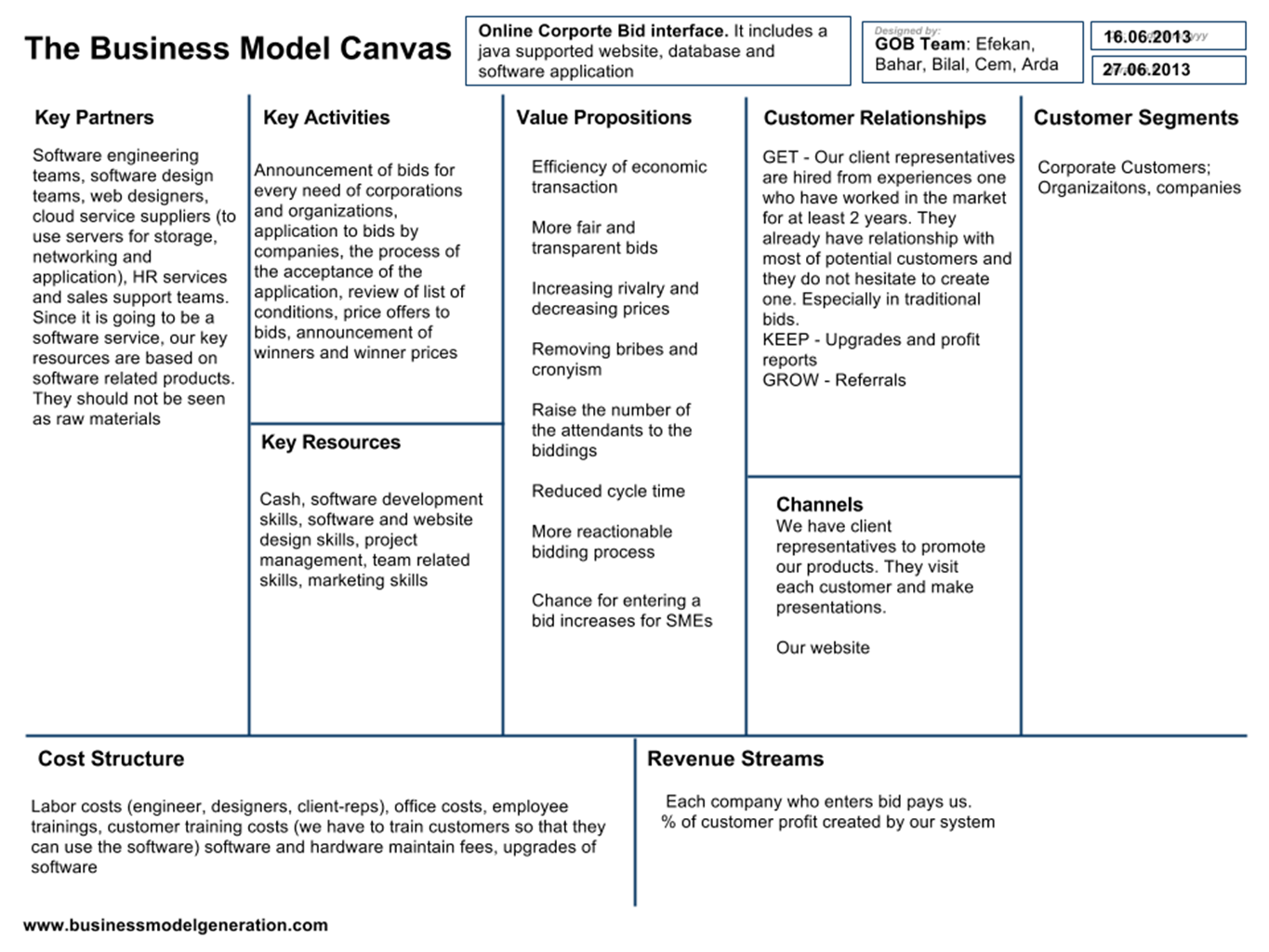
Last Tuesday, 9 July, Bahar and I made an interview with Baris Bicimseven. Today, we made another one with him, and he really contributed on our last business model canvas. He already told us golden contributions, today he mentioned about another things;
-He told us about marketing that getting customer is the most critical point and corporate customers does not favor changing their suppliers very often. It is because that as changing suppliers, swicthing costs can break out and it is really high.
-He emphasized the most important point that adopting this software and new tender system can require operational changes and it can cause high switching costs. Hence, we should do a good job in justifying our product's value proposition.
-Moreover, at operational level, compability of our system with other business software (ERP, SAP etc.) may be an issue, however a competitive edge if we can manage to integrate our software with other. This can be challenge for our technical personel.
These are last contributions from Baris Bey. We sent him our last canvas, and he will try to make another contributions as soon as possible.

Friday, July 12, 2013

List of Potential Customers

We have 14 customers. These firms have automotive factories in Turkey:
  1. Anadolu Isuzu: Produces commercial vehicles in Kocaeli since 1965. Headquarters are in Kocaeli also. http://www.isuzu.com.tr/MainPage
  2. B.M.C.: Produces trucs in İzmir since 1964. Headquarters are in Izmir also. http://en.wikipedia.org/wiki/BMC_%28Turkey%29
  3. Ford Otosan: Produces cars in İzmit for 48 years. Headquarters are in Istanbul. http://en.wikipedia.org/wiki/Ford_Otosan
  4. Hattat: tractor production company. http://www.hattattarim.com.tr/
  5. Hyundai Assan: Production of Hyundai cars is handled in İzmit. http://www.kibarholding.com/sektor/hyundai_assan.aspx
  6. Karsan: They focus on public transportation and commercial vehicles. Sometimes they built cars for army if there is demand. The factories are in Bursa http://www.karsan.com.tr/default.aspx
  7. M.A.N. Türkiye: Truck and bus production company. The production handled in Istanbul and Ankara. http://www.tr.man-mn.com/tr/_irketimiz_hakk_nda/man_t_rkiye_a._/MAN_T_rkiye_A._.html
  8. M.Benz Turk: In Ankara and Aksaray, they manufcture busses and Trucks. http://www.mercedes-benz.com.tr/content/turkey/mpc/mpc_turkey_website/tr/home_mpc/passengercars/home/world/about/locations.0003.html
  9. Otokar: Commercial and miltairy vehicles produced in Sakarya. http://www.otokar.com.tr/en/
  10. Oyak-Renault: Factories for Renault cars are in Bursa. Headquarters are in Istanbul. http://www.otokar.com.tr/en/
  11. Temsa Global: Produces vehicles for public transportation in Bursa. Offices are in Istanbul http://www.temsaglobal.com.tr/tr/default.aspx
  12. TOFAŞ: Produces cars and semi products for Jeep, Ferrari, Ford, Dacia and Maserati. Factories are in Bursa, management is in Istanbul  http://www.tofas.com.tr/en/Pages/default.aspx
  13. Toyota: Toyota cars are factoried in Istanbul. The offices are also there. http://www.toyota.com.tr/
  14. Türk Traktör: The production and management facilities in Ankara. http://www.turktraktor.com.tr/
Most of companies are managed in Istanbul or near Istanbul. Our Company should be establieshed in Istanbul for that reason.


Efekan Güven

Interview with Mehmet Güner (Efekan Güven)

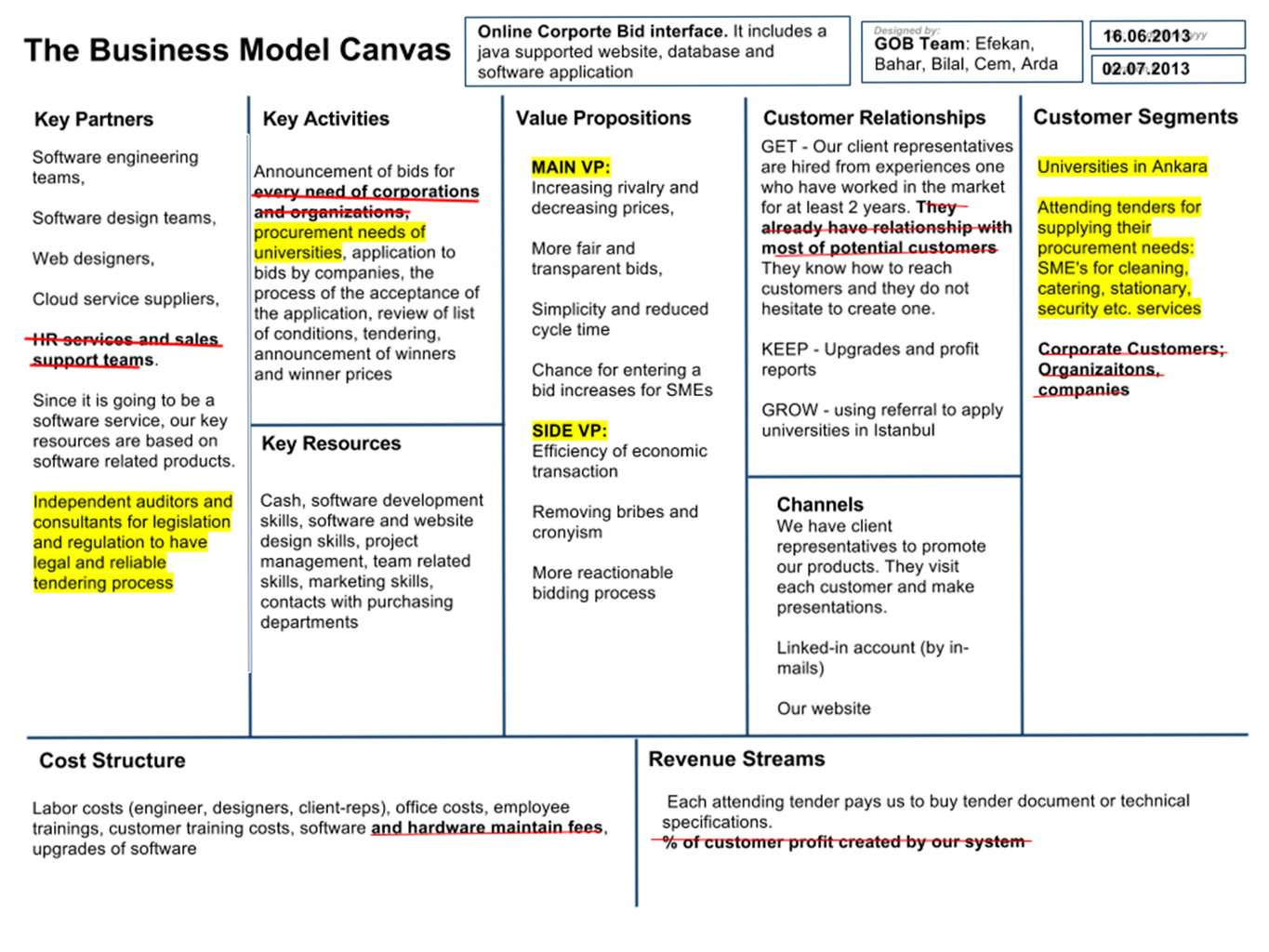
Mehmet Güner is currently STG manager of IBM in Ankara. Honestly, he is my manager :) STG is for Systems and Technology group and STG sells system x servers, power microprocessors, storage systems and pure flex servers. Mehmet Güner graduated from METU, the Department of Business Administration. he worked for KocSistem as Group Manager for more than 14 years, then he became Sales Manager in Siemens. After that he was elected as assistant general manager at Cisco. Finally, he is in IBM as STG manager. He has so many experiences with procurement process and software sales. I tested so many hypothesis of us like our target market and subscription model. After the interview, I was like "OMG! let's change everything again!". Because our hypothesises have failed again. Not everything was that much pessimistic about us. He clearly understand what our product is and why it is good for customer. He told me our main VP without waiting my explanations. Let me explain his advices and feedback:

First; he offered that we should not work with universities. Because they make standard procurements and and they procure products that have little variety. Rather than that; we have to work with factories or merchandise product manufacturers. Besides, the product should be complicated and should be produced by using so many raw material and semi-products. Those sectors target economies of scale (minimum average cost) and the prices in that sectors depend on the country that you import the raw material, daily changes in economy and the connections of the importer. Therefore, taking prices from so many companies that has different global connection would attract these sectors. I directly asked for a sector name and he replied with white goods and automotive sectors. I pushed him upon automotive and he continued. He said ford purchases carburettor more that one companies. It is just one of the thousand pieces of a car. Ford factories in Bursa can enjoy our offer since the prices are changeable among different suppliers from different parts of the world. Besides; financial evaluations will e more practical with an online bid interface. It is easy to evaluate costing criterion.

Second important point is about revenue model. He said you have to supply know-how services to apply subscription model; because that is how software sector goes. However; we cannot sell know-how according to him. The reason he explained is critical. We cannot know about automotive more than the guys in that sector. We have to knnow where to stop; we are just software sellers. The I asked how software guy make money. The answer is taking money from UPGRADES, INITIAL PRICE and CUSTOMIZATION. By customization; he means different requirements of different customers. For example, some might have transportation unit and some might be outsourcing transportation services. Different requierement will cost to customers.

Efekan Güven